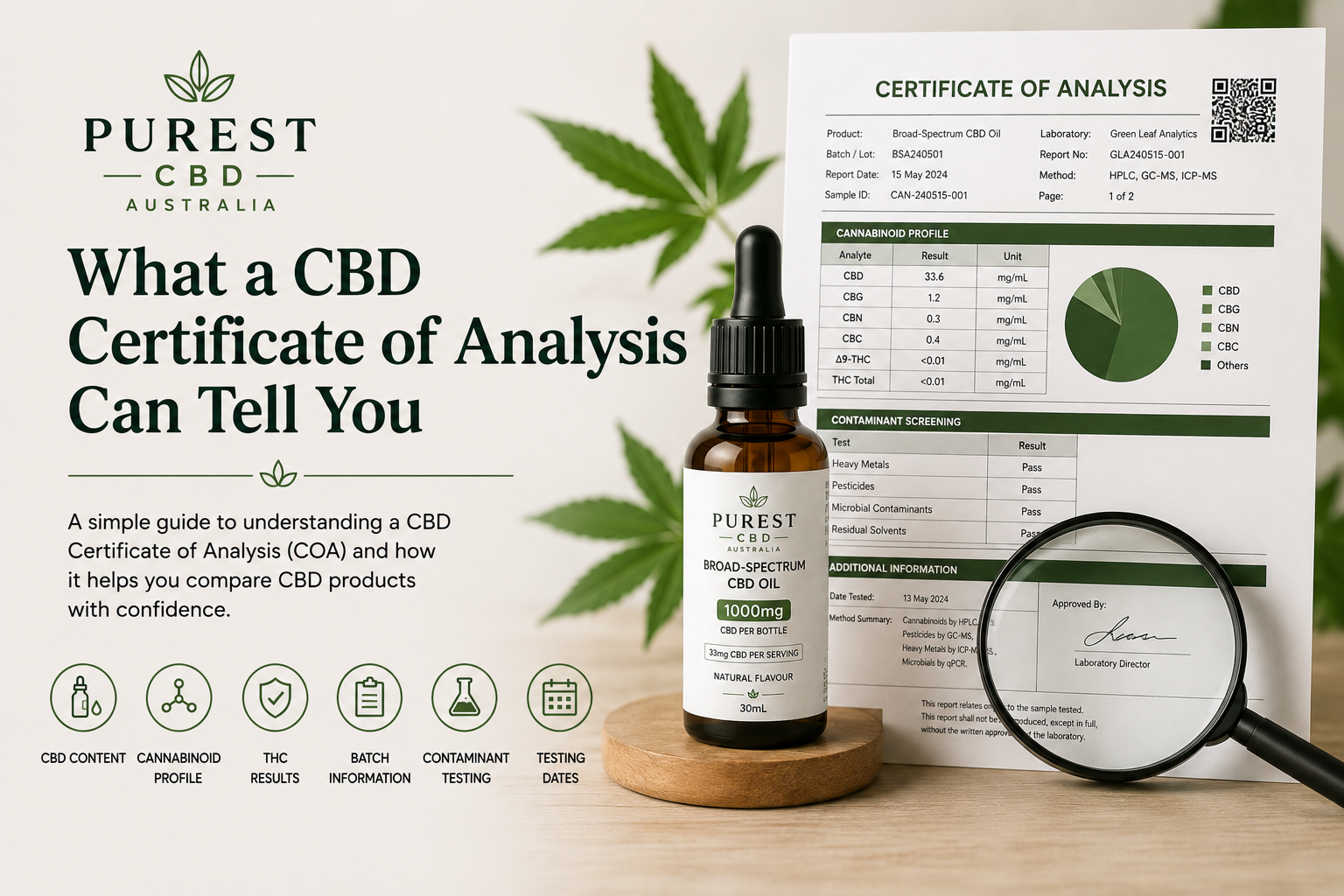
A Certificate of Analysis, often shortened to COA, is a laboratory report that provides information about the contents and testing of a particular product batch.
For CBD products, a COA can help you check whether the information on the product label is supported by laboratory testing.
What Information Can a CBD COA Include?
The exact information shown on a Certificate of Analysis can vary between laboratories and products.
A CBD COA may include details such as:
- CBD concentration
- Other detected cannabinoids
- THC test results
- Batch or lot number
- Testing date
- Laboratory details
- Contaminant screening
- Other quality-control results
Not every COA contains the same tests, so it is important to read the report rather than relying only on the presence of a certificate.
Check the CBD Content
One of the main things to look for is the reported CBD concentration.
Compare the laboratory result with the amount of CBD stated on the product label.
Depending on the report, CBD may be shown as a percentage, milligrams per gram, milligrams per millilitre or another measurement.
Make sure you are comparing the same type of measurement before deciding whether the figures match.
Look at the Cannabinoid Profile
A cannabinoid profile shows which cannabinoids were detected in the sample and, in many cases, their measured concentrations.
For broad-spectrum CBD products, this section can provide useful information about the cannabinoids present in the tested batch.
It may also show the laboratory result for THC.
Match the Batch Number
Where possible, check that the batch or lot number on the COA matches the batch number printed on the product packaging.
A COA applies to the sample or batch that was tested.
Matching these numbers helps confirm that you are looking at laboratory information relevant to the product you have.
Check the Testing Date
The testing date can help you understand when the laboratory analysis was completed.
A recent report that matches the current product batch is generally more useful than an older report for a different batch.
Look for Contaminant Testing
Some Certificates of Analysis include additional screening beyond cannabinoid content.
Depending on the laboratory and the testing requested, this may include results for substances such as:
- Heavy metals
- Pesticides
- Microbial contaminants
- Residual solvents
These sections are usually shown separately from the cannabinoid profile.
Check the Laboratory Details
A COA should clearly identify the laboratory that performed the analysis.
Look for information such as the laboratory name, report number, testing date and sample identification.
Some reports may also include verification features such as a QR code or online report reference.
Why COAs Are Useful When Comparing CBD Products
A Certificate of Analysis gives you information that cannot always be determined from the front of a product label alone.
When comparing CBD products, you can use the label and COA together to check:
- The stated CBD content
- The reported cannabinoid profile
- THC test results
- Batch information
- Testing dates
- Available contaminant screening
Clear product information and accessible laboratory reports make it easier to understand what has been tested in a particular CBD product batch.
CBD Product Information at Purest CBD Australia
Purest CBD Australia provides broad-spectrum CBD products across several product formats.
When laboratory information is available for a product, check that the report relates to the correct product and batch and read the results alongside the information provided on the product label.
Recent Comments